
Table Top vs. Semi-Automatic vs. Fully Automatic
How to match labeling equipment to your products, your volumes, and your growth — and avoid the costly mistakes that show up downstream.
Summary
A label is the smallest, least expensive component on most packages — and one of the most consequential. It carries the brand a buyer recognizes on the shelf, the lot and date codes that make a product traceable, the barcodes that move it through distribution, and the allergen and ingredient statements that keep it compliant. When a label is crooked, illegible, or simply wrong, the cost is rarely limited to the label.
That cost is measurable. In 2024, label errors were the single leading cause of food recalls in the United States, accounting for roughly 45 percent of all recall events and an estimated $1.92 billion in direct industry expense, with the average recall calculated at about $10 million. The overwhelming majority of those label-driven recalls stemmed from undeclared allergens — a labeling and application failure, not a contamination event.
Choosing how labels go onto products is therefore a production decision with quality, compliance, and cost implications, not a purchasing afterthought. This guide explains the three core categories of label application equipment — table top, semi-automatic, and fully automatic — how they differ in throughput, accuracy, and integration, and how to match a category to real operating conditions. It closes with a decision framework, a look at why the label itself is as important as the machine that applies it, and the questions worth answering before any equipment is quoted.
| At a glance
Table top dispensers peel and present a label for hand placement — ideal for low volumes, high product mix, and tight footprints. Semi-automatic systems power the cycle and position the product, delivering repeatable placement on round and shaped containers at moderate volumes. Fully automatic systems run inline with the production line, applying labels at high speed with sensor-driven precision and minimal operator effort. |
Not sure where to start? Use our two free tools. We built two tools to take the guesswork out of this guide. The Label Applicator Selector asks five quick questions about your products and volumes, then points you to the right category — table top, semi-automatic, or fully automatic — and the systems that fit. When you’re ready to get specific, the Label Application Questionnaire captures the product, label, and line details our team needs to recommend an exact configuration and prepare an accurate quote. Start with the Selector to find your direction, then use the Questionnaire to dial in the details
Why Label Application Is a Production Decision
It is tempting to treat labeling as the last, simplest step in packaging. In practice it sits at the intersection of brand, compliance, and operational throughput, and it tends to expose weaknesses in all three when it is under-resourced.
The compliance stakes are rising – Regulatory scrutiny of what appears on a package — and whether it is applied correctly and legibly — continues to intensify. Undeclared allergens alone accounted for the large majority of label-related recalls in recent analysis, and recall events have trended upward over the past several years. A misapplied, smeared, or missing label is not a cosmetic problem when it carries an allergen statement, a lot code, or a barcode that a distributor scans at receiving.
Labor is scarce, and manual labeling is fragile – The labor market for production and packaging roles remains exceptionally tight, with industry surveys reporting close to one job opening for every unemployed worker and more than half of packaging companies actively investing in automation to close workforce gaps. Manual, hand-applied labeling is the most exposed process in that environment: it is slow, it varies between operators and shifts, and it is difficult to staff consistently. As volume grows, hand labeling becomes the bottleneck that caps output and introduces the most variability.
The economics favor the right-sized investment – Automation in packaging is no longer framed purely as cost reduction; it is increasingly a way to stabilize output, protect quality, and free skilled people for higher-value work. Reported payback windows for packaging automation commonly fall in the range of 12 to 24 months, depending on volume and the labor it displaces. The point is not that every operation needs a fully automatic line — it is that the application method should be matched deliberately to volume and risk, rather than defaulting to whatever was in place when volumes were lower.
| The core question
The right applicator is not the fastest one or the cheapest one. It is the one whose throughput, accuracy, and integration match your actual products, volumes, and growth trajectory — with enough headroom that you are not replacing it in twelve months. |
The Three Categories of Label Applicators
Label application equipment spans a continuum from operator-driven dispensing to fully integrated, sensor-controlled systems. The three categories below are the practical decision points along that continuum. A fourth capability — print-and-apply — cuts across all three and is covered separately, because it changes what a label can carry.
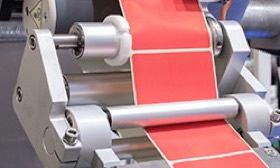
1. Table Top Label Dispensers – A table top dispenser automates the most error-prone part of hand labeling: separating the label from its liner. The machine advances the web, peels the label at a fixed edge, and presents it ready to grasp, while a photo-eye sensor stops each label in the same position every cycle. The operator places the label on the product. Scrap liner is rewound automatically to keep the workstation clean.
Where it fits
- Low-to-moderate volumes — from a few dozen to several hundred pieces in a session.
- High product mix and frequent changeovers, where a flexible bench station beats a dedicated line.
- Flat panels, gentle curves, and short runs where hand placement is acceptable and capital is constrained.
- Startups and growing brands establishing a repeatable process before committing to inline automation.
What to look for – Representative table top units such as Elmark’s TAL series illustrate the specifications that matter. The TAL-450, for example, is a U.S.-built stainless and powder-coated steel dispenser that handles label rolls up to 12 inches in diameter, labels up to 4.5 inches wide, a heavy-duty motor with overload protection, an adjustable unwind tension system, full scrap rewind, and a vertical peel edge for visibility and operator comfort. The lighter-duty TAL-250 and the heavy-duty TAL-750HD bracket that capability above and below, and portable units such as the Cosmos models plug into a standard outlet for benchtop use.
| Strengths and limits — Table Top
Strengths: lowest cost of entry, minimal footprint, fast to deploy, forgiving of product variety, easy to operate. Limits: throughput and placement accuracy are bounded by the operator; not suited to high volumes, tight registration tolerances, or fully wrapped round products. |
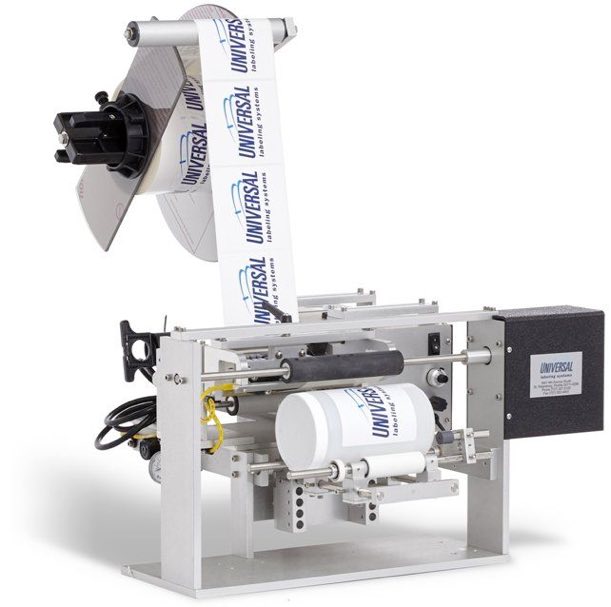
2. Semi-Automatic Label Dispensers – Semi-automatic systems take the next step: the machine controls the application cycle, not just the dispensing. The operator loads a product and triggers the cycle — often with a foot switch — and the system applies the label with consistent pressure and registration. For round products, a roll-on station rotates the container so a label wraps smoothly and squarely every time. These systems are built for work-station applications and operations where no conveyor line exists, helping get the job done at a steadier pace than hand placement allows.
Where it fits
- Moderate volumes — hundreds to a few thousand products per day.
- Round and cylindrical containers: bottles, jars, vials, cans, and tubes that need a clean wraparound.
- Operations that need professional, repeatable placement without the cost or footprint of a full line.
- Single-label or front-and-back applications that benefit from consistent registration.
What to look for – A representative system such as Elmark’s Universal R310 round-product labeler is designed for businesses that want professional results without the cost of full automation. It applies labels to round products from small diameters up to gallon sizes, accepts label rolls up to 12 inches for longer runs between changes, offers single or front-and-back labeling, and is activated by a foot switch with fast changeover between product sizes. Optional kits for wide labels and hot-stamp imprinting extend its range. Key evaluation points across the category include changeover speed, the diameter and label-width range, roll capacity, and whether the unit can later feed into a more automated arrangement as volumes grow.
| Strengths and limits — Semi-Automatic
Strengths: repeatable accuracy on round products, meaningful throughput gains over hand labeling, modest footprint and cost, fast changeovers, a sensible step up for growing volume. Limits: still requires an operator per cycle; throughput is higher than table top but below inline automation; best suited to controlled, station-based work rather than continuous high-speed runs. |
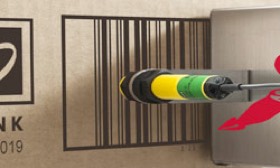
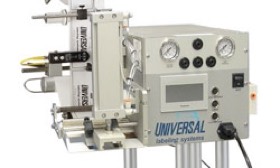
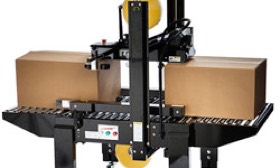
3. Fully Automatic Label Dispensers – Fully automatic systems integrate labeling into the production line itself. Product is metered onto a conveyor, sensed photoelectrically, labeled by a stepper-driven applicator, and carried on — all without an operator touching each piece. Encoder synchronization matches the applicator to line speed so placement stays accurate as the line runs, and the operator’s role shifts from applying labels to tending and monitoring the system.
Where it fits
- High volumes — thousands to tens of thousands of products per day, run continuously.
- Operations where placement accuracy and compliance cannot vary by operator or shift.
- Lines that combine labeling with coding, marking, or inspection in a single integrated pass.
- Round products, front-and-back formats, and complex applications at speed.
What to look for – High-speed round-product systems such as Elmark’s Universal R321 show what this category delivers. It dispenses labels at speeds up to 1,500 inches per minute, carries a 12-inch roll capacity to minimize changeovers, handles webs up to 6.25 inches wide, and uses photoelectric product and label sensors with encoder synchronization for precise wraparound placement. A UL-certified NEMA 12 control enclosure meets industrial safety standards, and the conveyor is built to drop into an existing line. Companion systems address adjacent needs — the R315 for small-diameter rounds, the R320 and high-speed R322 for heavier-duty and faster round-product work, and the CP1000 and CP2000 for front-and-back and contract-packaging formats. The specifications that matter most here are sustained speed at your label size, sensing and synchronization, roll capacity, enclosure rating, and how cleanly the system integrates with the rest of the line.
| Strengths and limits — Fully Automatic
Strengths: highest throughput and the most consistent accuracy, minimal per-unit labor, line integration with coding and inspection, the strongest compliance posture. Limits: highest capital investment and footprint; benefits depend on volume and uptime; best justified when sustained output, speed, or compliance requirements are clear. |
A Cross-Cutting Capability: Print-and-Apply
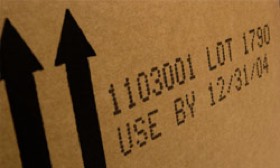
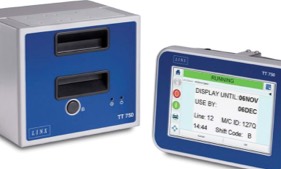
Print-and-apply systems combine two steps into one: they print variable data — barcodes, lot numbers, dates, serialized codes, weights — onto a label and apply it in a single automated pass. This matters wherever each label must carry information unique to the unit, case, or batch, which is increasingly the norm under traceability and serialization requirements. A unit such as Elmark’s Universal Print & Apply (UPA II) printer-applicator addresses general production labeling, while dedicated pharmacy print-and-apply systems serve regulated Rx environments. Print-and-apply can sit alongside any of the three categories above; it is a capability layered onto application rather than a fourth tier of automation.
Side-by-Side Comparison
The table below summarizes how the three categories compare across the considerations that most often drive the decision. Treat it as a starting point for narrowing the field, then validate against your specific products and labels.
| Consideration | Table Top | Semi-Automatic | Fully Automatic |
| Typical daily volume | Dozens to low hundreds | Hundreds to a few thousand | Thousands to tens of thousands |
| Operator involvement | Hands-on placement; machine dispenses | Loads and triggers each cycle | Tends and monitors the line |
| Throughput | Limited by the operator | Steady, repeatable cycles | Up to 1,500 in./min
label dispense |
| Placement accuracy | Depends on the operator | High and repeatable | Highest; sensor and encoder driven |
| Product types | Flat, modest curves, small batches | Round products: bottles, jars, vials, cans | Round, front-and-back, complex formats |
| Line integration | Standalone workstation | Standalone or assisted station | Inline with conveyor and coding |
| Footprint | Benchtop | Compact floor or bench | Full line; larger footprint |
| Relative investment | Lowest | Moderate | Highest; scales with output |
| Best fit | Low volume, high mix, startups | Growing volume, controlled cost | High volume, compliance, speed |
Speed and capacity figures reflect representative systems and vary by product, label size, and configuration. Confirm specifications against your application.
How to Choose: A Decision Framework
Equipment categories are easy to compare in the abstract and harder to choose between in practice, because the right answer depends on the interaction of several variables. Working through the following questions, in order, will point most operations toward the right category — and surface the trade-offs worth discussing with a supplier.
1. What is your real volume — today and in eighteen months? Be honest about both numbers. Sizing to today’s volume risks outgrowing the equipment within a year; sizing to an optimistic forecast risks paying for capacity that sits idle. Low and variable volumes favor table top. Steady, moderate volumes favor semi-automatic. High, sustained volumes favor fully automatic. The eighteen-month figure matters because changeover cost and disruption are real — a small amount of headroom is usually cheaper than a premature replacement.
2. What shape are your products, and how is the label applied? Round and cylindrical containers that need a wraparound label point toward roll-on semi-automatic or automatic systems engineered for that motion. Flat panels and simple curves are well served by table top dispensing. Front-and-back or multi-panel labeling raises the bar toward automatic systems built for it. Match the applicator to the geometry first — a fast machine that cannot wrap your bottle cleanly is the wrong machine.
3. How much variable information does each label carry? If every label is identical, a standard applicator fed with pre-printed labels is efficient. If each label needs a unique barcode, lot code, date, or serial number, print-and-apply belongs in the conversation regardless of which automation tier you choose. Traceability and serialization requirements tend to push operations toward printing variable data at the point of application.
4. What is the cost of a labeling error in your category? For regulated food, beverage, pharmaceutical, cosmetic, and chemical products, the downstream cost of a mislabeled unit — recall exposure, rework, regulatory action, and lost trust — dwarfs the price difference between equipment tiers. Where error cost is high, the sensor-driven consistency of automatic systems is part of the risk-management case, not just a productivity feature.
5. What labor can you reliably staff? If hand labeling is already a staffing or consistency problem, that is a strong signal to move up a tier. Semi-automatic systems reduce the skill and effort per cycle; automatic systems remove the per-unit labor almost entirely. In a tight labor market, the ability to hold output steady regardless of who is on shift is a tangible benefit.
6. How does this fit the rest of the line? Labeling rarely lives alone. If coding, marking, or inspection happen nearby, an automatic system that integrates them into one pass removes handoffs and reduces error. Even at lower tiers, it is worth asking whether today’s purchase can later feed into a more automated arrangement, so the first investment is not stranded by the second.
| A simple rule of thumb
Start with the constraint that hurts most. If cost and flexibility dominate, begin with table top. If repeatable placement on round products at moderate volume is the goal, semi-automatic is usually the answer. If volume, speed, or compliance is the binding constraint, fully automatic earns its cost — and pays it back fastest where it displaces the most manual labor. |
The Label Itself Is Half the System
It is easy to focus entirely on the machine and forget that an applicator is only as reliable as the label it runs. Application problems that look mechanical — labels that lift at the edges, jam on the peel bar, skew on the product, or smear a barcode — are frequently rooted in the consumable: the wrong adhesive for the surface or temperature, a face stock that does not suit the product, a die-cut or liner that does not feed cleanly, or a roll wound to the wrong core or diameter for the machine.
This is why the most reliable results come from specifying the label and the application method together. The roll specifications a dispenser depends on — core size, outer diameter, web width, die-cut geometry, and matrix — are label decisions. So is the adhesive that determines whether a label holds on a cold, damp bottle or a curved, low-energy plastic. So is the face material and finish that survive handling, moisture, and abrasion through distribution while still scanning and reading correctly.
Why this favors a single source
Sourcing equipment and labels from the same partner closes the gap where most application problems live. Elmark has printed billions of labels and supplies custom labels engineered specifically for automatic application — produced with both digital and offset printing and matched to the equipment that will run them. That capability spans:
- Materials: vinyl, BOPP, PET, polyester, and paper face stocks; foils, mylar, and films; clear over-lamination for durability.
- Adhesives: permanent, removable, and repositionable constructions, with a wide range of adhesive, face, and liner combinations to match the product surface and environment.
- Finishes and effects: matte, gloss, metallic foiling, UV varnish, embossing, debossing, and back printing for shelf presence.
- Constructions and formats: die-cut pressure-sensitive labels, piggyback coupon labels, direct-thermal and thermal-transfer stocks, rolls, sheets, fan-folded, butt-cuts, perforations, and scores.
- Compliance-ready printing: barcodes, batch and lot codes, and the variable data that traceability requires — plus printed shrink sleeves and tamper-evident banding where the package calls for it.
| Specify the label and the applicator together
A label designed for automatic application — right adhesive, right face stock, right roll and die-cut specifications — is what lets an applicator run at rated speed with clean placement and a readable code. When the two are engineered as one system, the most common application failures simply do not occur. |
Looking Beyond the Purchase Price
The quoted price of an applicator is one line in a longer ledger. A sound decision weighs the total cost and value over the equipment’s working life:
- Labor per unit. The single largest variable between tiers. Automatic systems carry higher capital cost but the lowest labor per unit; table top carries the lowest capital cost but the highest labor per unit. Volume determines which dominates.
- Throughput and uptime. Faster equipment only pays off if it runs. Roll capacity, changeover speed, and build quality all affect realized output, not just rated speed.
- Error and rework cost. Misapplied labels, downtime, and — in regulated categories — recall exposure can outweigh equipment cost differences entirely.
- Consumables and fit. Labels engineered for the machine reduce jams, waste, and rejects. A small premium on a correctly specified label often pays for itself in uptime.
- Service and support. Access to parts, service, and technical help keeps a line moving. Equipment backed by responsive support and a parts supply has a lower true cost than a cheaper unit that sits idle waiting for help.
Across these factors, the lowest-price option and the lowest-cost option are frequently not the same. The objective is the configuration that delivers reliable, compliant labels at your volume for the lowest total cost over time.
Five Avoidable Mistakes
- Buying for today’s volume only. Outgrowing an applicator within a year means paying twice. Build in modest headroom.
- Choosing speed over fit. A fast machine that cannot wrap your container or carry your variable data cleanly is slower in practice than a well-matched slower one.
- Treating the label as an afterthought. Most “machine” problems are label problems. Specify the consumable with the equipment.
- Ignoring integration. Labeling that does not coordinate with coding, marking, and inspection creates handoffs where errors accumulate.
- Underweighting support. Parts availability and technical service determine real-world uptime more than the spec sheet does.
About Elmark Packaging
Elmark Packaging has been adding information to products and packages since 1980, with more than 40 years of marking, coding, and labeling experience. Based in West Chester, Pennsylvania, Elmark provides label application equipment across the full range covered in this guide — table top dispensers, semi-automatic systems, fully automatic round-product and front-and-back lines, labeling heads, and print-and-apply applicators, including dedicated Rx pharmacy systems — alongside coding, marking, code-dating, shrink sleeving, and secondary packaging equipment.
Beyond equipment, Elmark is a full-service custom label printer. Having produced billions of labels with both digital and offset printing, Elmark supplies labels for virtually any product or industry — food and beverage, pharmaceutical, cosmetic, retail, and industrial — across vinyl, BOPP, PET, polyester, paper, foils, and films, with finishes ranging from matte and gloss to metallic foiling, UV varnish, embossing, and debossing. Custom sizes and shapes, a wide range of adhesives, compliance-ready barcodes and lot codes, and short or high-volume runs are all handled in-house, whether a label is applied by machine or by hand.
| Talk through your application
Elmark Packaging 901-J South Bolmar Street, West Chester, PA 19382 Phone: 1-800-670-9688 | 610-692-2455 Email: info@elmarkpkg.com |
Sources & Further Reading
Industry and regulatory references
- New Food Magazine, “Label errors dominate 2024 US food recalls, costing industry $1.92 billion” (analysis of FDA Enforcement Report data by Loftware; recall-cost figures per Grocery Manufacturers Association and Food Marketing Institute).
- U.S. Food and Drug Administration, “Recalls, Market Withdrawals, & Safety Alerts” and FDA Recalls Data Dashboard.
- U.S. Department of Agriculture, Food Safety and Inspection Service, “Recalls & Public Health Alerts” and Annual Recall Summaries.
- PMMI — The Association for Packaging and Processing Technologies, 2025 Economic Outlook (packaging automation investment and labor-market findings), as reported in industry coverage.
- Food Industry Executive, “Case Packing and Palletizing Automation in 2026” (A3 robot-order data; food and consumer-goods automation growth).
- Weldmaster, “Top 2026 Packaging Automation Trends Guide” (automation ROI timelines and labor trends).
- Future Market Insights, “End-of-line Packaging Market” (market sizing and the role of high-speed labeling within end-of-line automation).
Elmark Packaging product references
- Elmark Packaging — Label Applicators overview, including Table Top, Semi-Automatic, and Fully Automatic dispensers and Print & Apply applicators. elmarkpkg.com/products/label-applicators
- Elmark Packaging — TAL-450 table top dispenser and TAL series specifications. elmarkpkg.com/product/tal-450-with-photo-eye
- Elmark Packaging — Universal R310 semi-automatic round-product labeling system. elmarkpkg.com/product/r310-round-product-labeling-system
- Elmark Packaging — Universal R321 high-speed round-product labeling system specifications. elmarkpkg.com/product/r321-round-product-system
- Elmark Packaging — Custom Printed Labels: materials, adhesives, finishes, and converting capabilities. elmarkpkg.com/label-printing
This white paper is provided for general informational purposes. Equipment specifications, speeds, and capacities are representative and vary by product, label, and configuration; confirm details for your specific application. Statistics cited reflect the most recent figures available from the referenced sources at the time of writing.